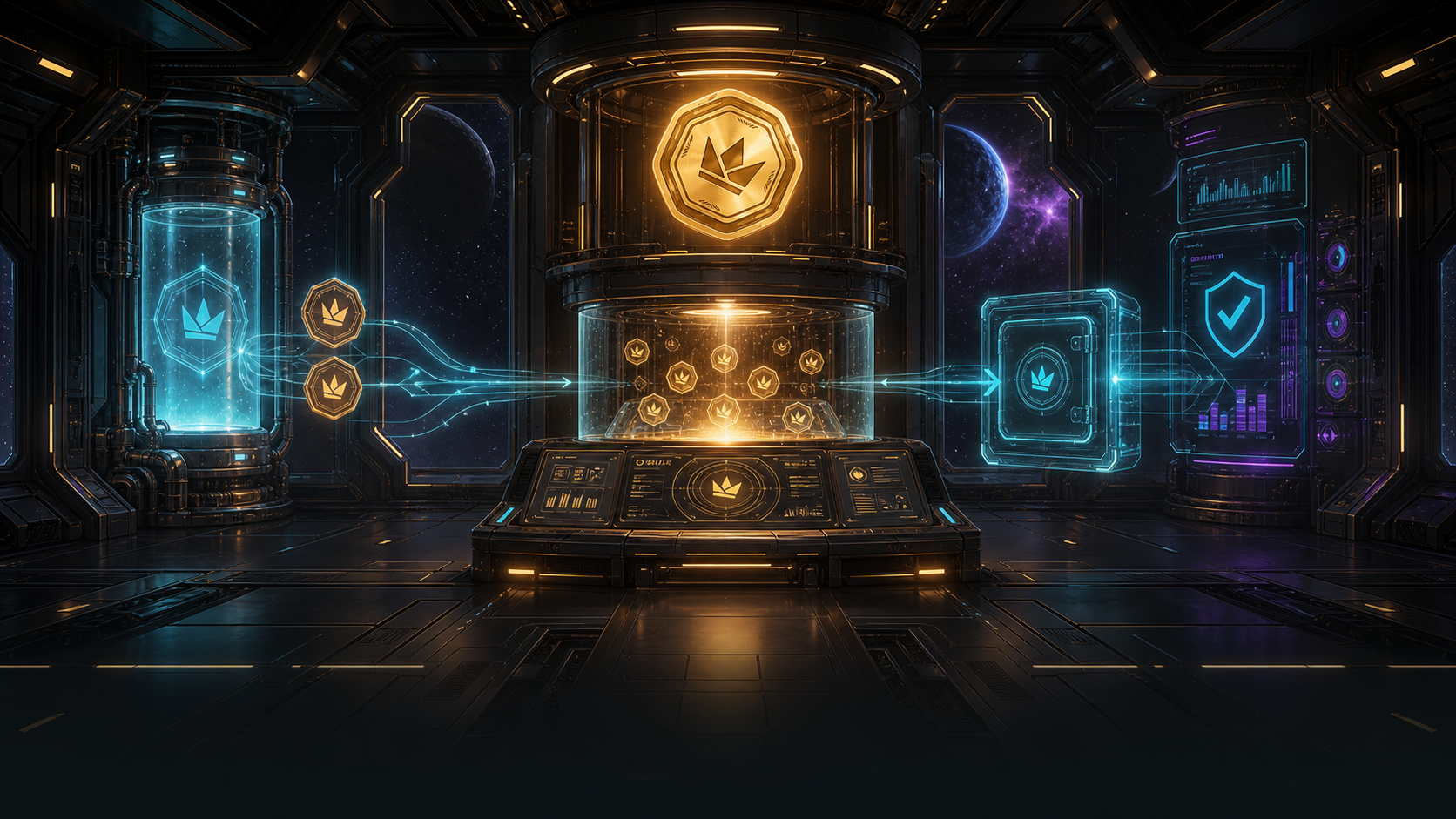
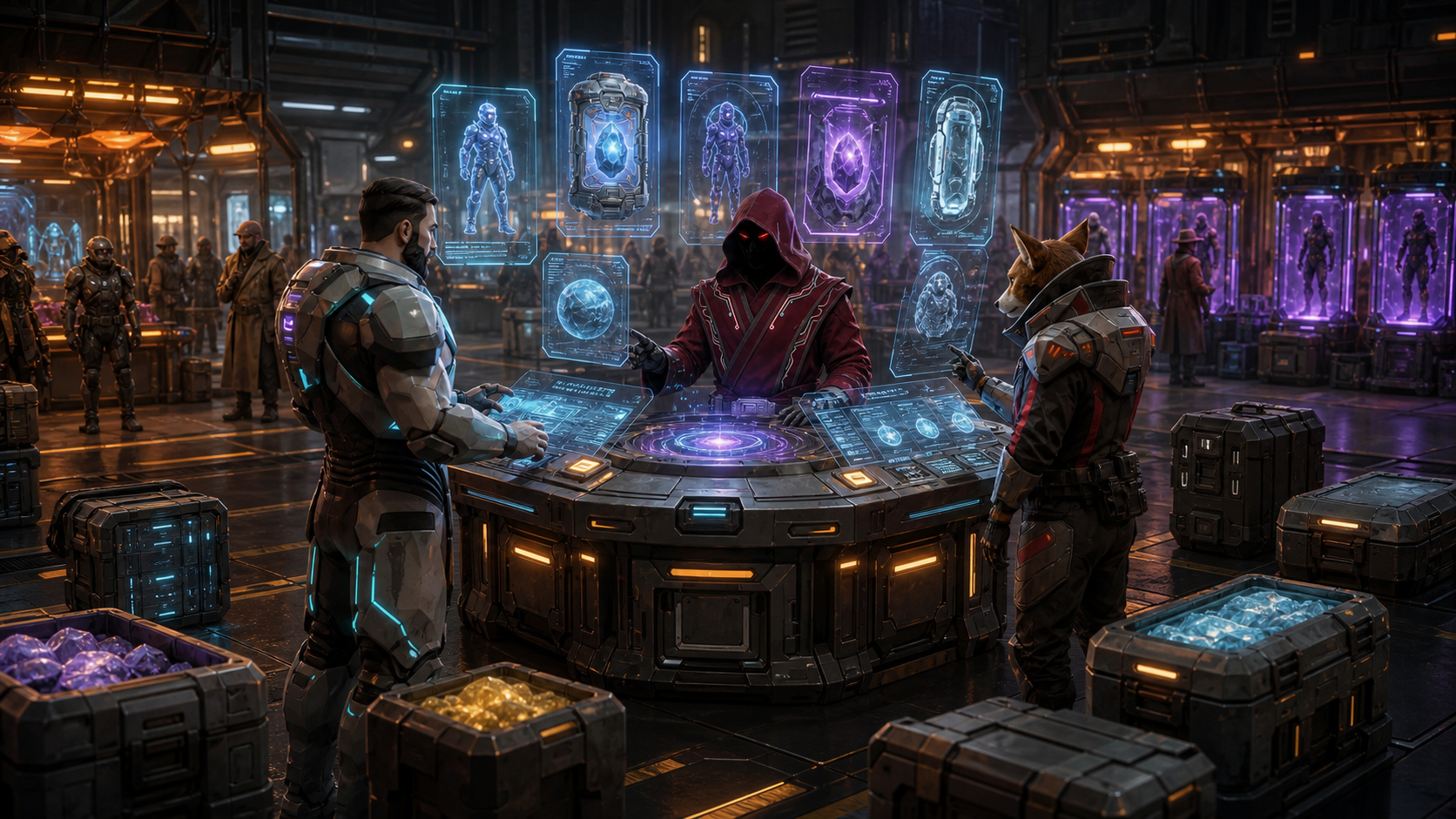
Play the game. Buy with cards or stablecoins. Help reduce $MISFIT supply. The planned economy connects card and stablecoin deposits and on-chain trading to token buybacks and burns, while trading fees also fund stablecoin rewards for active players.
Token
$MISFIT
Card / Stablecoin Deposit Burn
2%
Planned Swap Fee
1.25%
Important notice: This page describes game utility, technical architecture, and current product design. It is not an offer to sell securities, a promise of profit, or financial advice. Gameplay balances, fees, availability, chains, and payout policies may change as Misfit Galaxy evolves.
01 / Platform Thesis
Game Utility Before Crypto Speculation
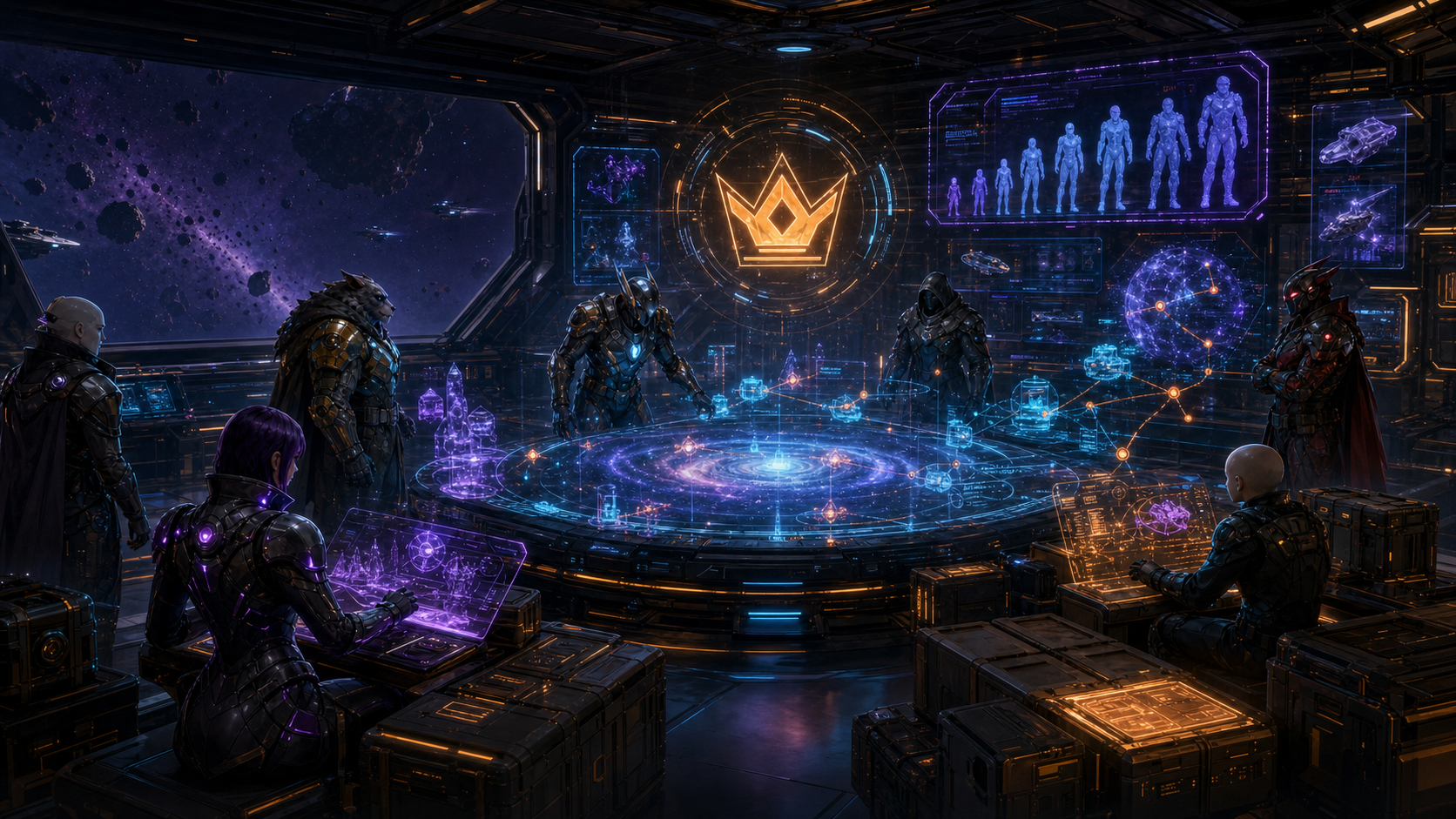
Misfit Galaxy is an action MMO space shooter with an economy shaped by play: fighting, mining, hauling, trading, crafting, and upgrading. The crypto layer exists to support player ownership and portability where it adds value, while core gameplay remains server-authoritative and balanceable.
The platform combines a PlayFab-backed game ledger, an Express/Mongo backend, card and stablecoin payment plans, and Enjin services for selected owned assets. Players will not need to buy or hold $MISFIT to make in-app purchases with a credit card.
Design Principles
Gameplay actions create the primary demand for assets and currency.
Ownership is useful only when it improves identity, access, trading, or portability.
Ongoing rewards are funded by revenue; $MISFIT is not newly minted to pay players.
Custodial and self-custody wallet paths coexist so crypto-native and mainstream players can both participate.
PlayCombat, mining, hauling
Earn/SpendIn-game CROWN, BITS, resources
OwnClones, ships, tokens
TradeMarketplace and contracts
Two Revenue Streams, One Flywheel
Every credit card or stablecoin deposit contributes 2% of its value to $MISFIT buybacks and burns. Every swap through the planned $MISFIT Uniswap v4 pool contributes to liquidity, buybacks and burns, and a stablecoin rewards pool for active gamers.
Deposit → Burn
A 2% fee on credit card and stablecoin deposits goes entirely toward buying and burning $MISFIT.
Trade → Burn + Reward
A planned 1.25% swap fee allocates 0.25% to liquidity, 0.5% to automatic $MISFIT buybacks and burns, and 0.5% to stablecoin rewards based on in-game transaction volume and playtime.
Players get familiar ways to pay and a reason to stay active. The token gets two sources of burn funding, including credit card and stablecoin deposits. The rewards pool grows with trading fees collected rather than newly issued tokens.
Design status: These are the planned fee and reward mechanics. Launch details, supported payment methods, the Uniswap v4 network and pool, and reward rules will be published before activation.
02 / Economy Model
Multiple Loops, One Player Ledger
Misfit Galaxy uses regular game resources, BITS for common upgrades and crafting, and in-game CROWN for premium utility. In-app purchases will use stablecoins and/or credit cards. $MISFIT connects to this activity through fee-funded buybacks and burns; players do not need to acquire a new token to spend.
Resource Production
Players create economic activity through mining, combat drops, NPC kills, contracts, station work, and module/component crafting. These actions supply raw inputs for ships, clone augmentation, and marketplace listings.
Spending Sinks
Clone purchases, premium crafting, augmentation, and other purchasable content give players reasons to spend. Each credit card or stablecoin deposit carries a 2% fee, all of which funds $MISFIT buybacks and burns. Spending existing CROWN, BITS, or materials is a separate game-ledger action, not an additional burn of the full purchase value.
Player Markets
The marketplace supports resources and tradable digital assets, including capsules and augmented clones. Listings are handled through REST for predictable performance with minimal real-time alerts.
Settlement Paths
Some in-game CROWN remains normal gameplay balance. Eligible profit can enter a cashable accounting path where withdrawals and settlements are processed in USDC on Solana, subject to thresholds, tax, reserve policy, and review.
03 / The $MISFIT Flywheel
Deposit → Burn; Trade → Burn + Reward
$MISFIT is the token at the center of the planned Misfit Galaxy flywheel. Card and stablecoin deposits and token trading each fund buybacks and burns. Trading also funds stablecoin rewards for the most active gamers, measured by in-game transaction volume and playing time.
Players can pay by credit card without handling crypto, or use supported stablecoins. The company handles the deposit-fee allocation and the $MISFIT buyback and burn behind the scenes.
Where Each Fee Goes
Planned allocations as a percentage of deposit or swap value
Allocation
Card / Stablecoin Deposit
Designated Pool Swap
Buy & Burn
2%
0.5%
Player Rewards
—
0.5%
Liquidity
—
0.25%
Company
0%
—
Total Fee
2%
1.25%
Card And Stablecoin Deposits: Fund Token Burns
Every credit card or stablecoin deposit will carry a 2% fee collected by the company. The full fee funds $MISFIT buybacks and permanent burns; none of this fee is retained as company revenue. Spending an existing in-game balance does not trigger this deposit fee again.
On-Chain Trading: Liquidity, Burns, And Player Rewards
The planned fee on swaps through the designated $MISFIT Uniswap v4 pool is 1.25%. Of the swap value, 0.25% is allocated to adding liquidity. The remaining 1% is split equally: 0.5% funds automatic $MISFIT buybacks and burns, and 0.5% is converted to stablecoins for the gamer rewards pool.
The 0.25% liquidity allocation is Misfit Galaxy's chosen design, not a mandatory Uniswap v4 requirement. Uniswap distinguishes LP fees from custom hook fees; the final pool and hook configuration must implement the stated allocation. The fee applies to swaps routed through that pool, not every wallet transfer or trade on another venue. See Uniswap's fee documentation.
Get Rewarded For Playing
The rewards pool pays active gamers in stablecoins, with participation measured by in-game transaction volume and playing time. Holding $MISFIT alone does not earn these gameplay rewards. The pool is funded by collected trading fees, so the available reward budget depends on actual trading activity.
The scoring weights, qualifying transactions and playtime, payout schedule, and checks against bots and artificial activity remain to be finalized before launch. Playing or spending does not guarantee a fixed payout.
A simple example: A $100 credit card or stablecoin deposit generates a $2 fee, all allocated to $MISFIT buybacks and burns, with $0 allocated to the company. A $100 swap generates a planned $1.25 fee: $0.25 for liquidity, $0.50 for buybacks and burns, and $0.50 for player rewards. These illustrate allocations, not token-price or earnings forecasts; network and other applicable charges are separate.
Why The Model Connects
Card and stablecoin deposits support burns even when players never trade $MISFIT. Token trading supports both burns and rewards that give players another reason to return. These are two distinct funding sources, although game activity and trading activity can still move together. Completed burns reduce token supply; the number of tokens removed depends on execution prices and costs.
04 / $MISFIT Launch
Robinhood Launch and Tokenomics TBD
Misfit Galaxy plans to launch $MISFIT on Robinhood. Launch timing and availability details will be announced as they are finalized.
Tokenomics are TBD. Total supply, launch price, allocations, liquidity arrangements, and any vesting or unlock schedules will be published when finalized.
Planned LaunchRobinhoodTiming to be announced
TokenomicsTBDDetails to be announced
Total SupplyTBDTo be finalized
Launch PriceTBDTo be finalized
Utility and Burn Mechanics
The planned model uses a 2% credit card and stablecoin deposit fee, allocated entirely to $MISFIT buybacks and burns. Players pay with credit cards or stablecoins rather than needing $MISFIT to make purchases.
Swaps through the designated Uniswap v4 pool have a planned 1.25% fee: 0.25% for liquidity, 0.5% for automatic buybacks and burns, and 0.5% for stablecoin player rewards. The token network, pool address, and hook deployment details remain to be confirmed for this model.
Deflation through use: completed burns permanently remove tokens from supply. Buyback budgets are not completed burns, and supply reduction does not guarantee a higher market price.
04 / Clone Ownership
Clones Become Stateful Game Assets
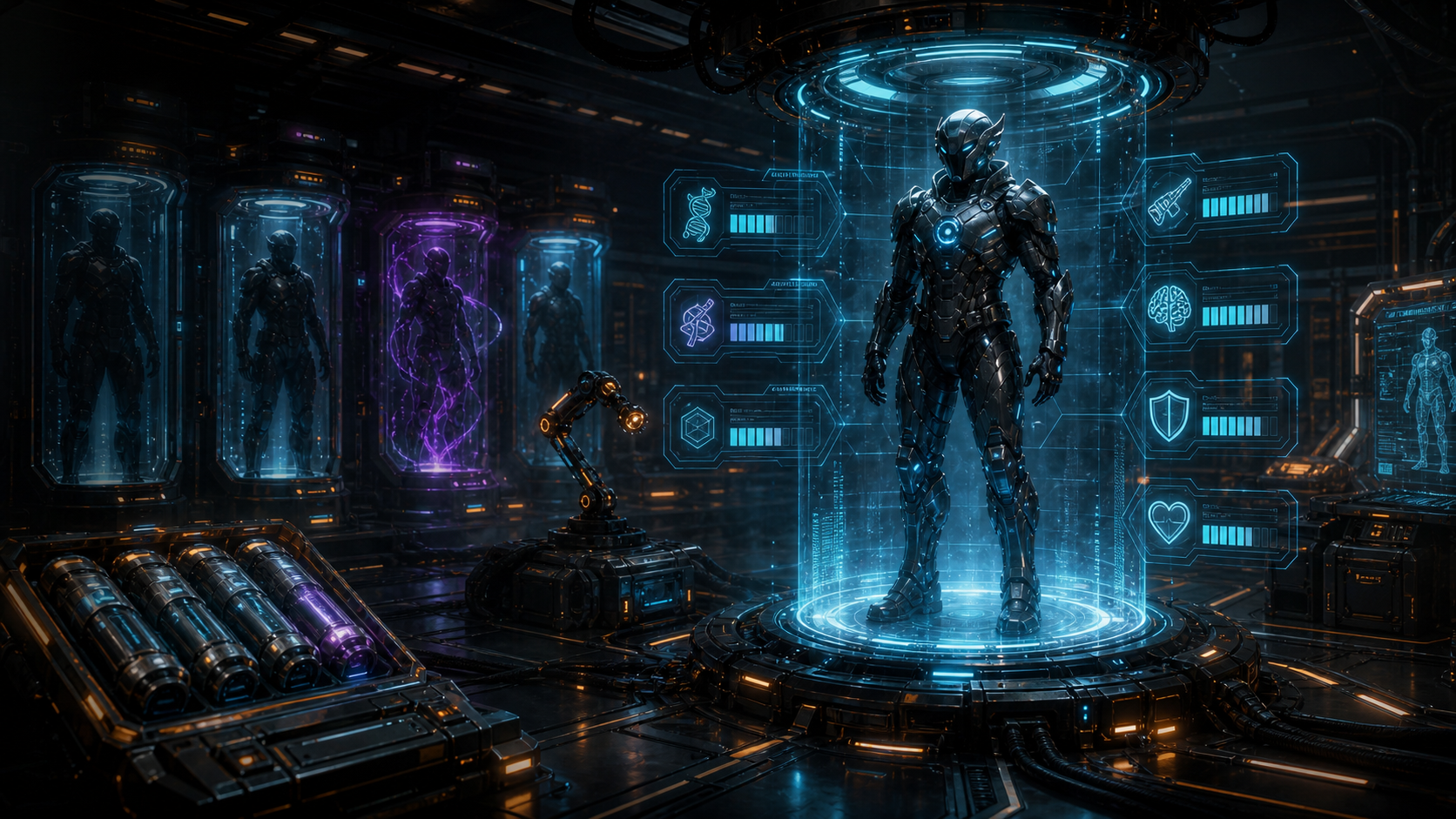
Clones are designed as owned player identities and upgradeable assets. The augmentation system uses four stat slots, server-side randomization, roll-session persistence, stat locking, capsule targeting, and Enjin metadata enrichment when augmented clones are finalized.
Capsules are split across Tank, Pirate, Weapon, Mining, Rift, Support, and Trader families. Generic capsules remain the cheaper broad-roll path. Typed capsules focus the roll pool without guaranteeing every result. Corrupted capsules add higher-risk, higher-cost variants and include lock rules that prevent stacking corrupted locks without first unlocking the existing corrupted stat.
Clone Progression Creates Repeat Utility
Clone purchases and premium augmentation create repeat demand as players improve their builds. Credit card and stablecoin deposits carry the planned 2% fee, all of which funds $MISFIT buybacks and burns. BITS and materials used in augmentation remain separate game costs.
Stat Slots
Current clone augmentation treats active/basic clones as four-slot assets.
Capsule Costs
Reference costs include 500 in-game CROWN to buy a stat capsule and 1,500 BITS plus 8 Obscurian to craft one.
Locks
Locking one stat for reroll costs 500 BITS, and at least one slot must reroll.
Metadata
Finalized augmented clones carry build class, set bonus, family context, stats, and corruption data.
05 / Marketplace
A Hybrid REST Market For Game Assets
The marketplace supports active listings, item details, direct purchases, sell listings, user listings, order books, order cancellation, trade history, and market stats. The current architecture favors REST browsing and purchasing, with WebSocket alerts reserved for new listing notifications.
Marketplace inventory includes resources, capsules, clones, augmented clones, and other tradable NFT views. Seller proceeds are tracked in the in-game economy and can become eligible for USDC settlement where applicable, while marketplace fees, associated $MISFIT burns, and revenue-funded ownership participation are accounted for separately.
Deposits Support Burns; Trading Supports Rewards
Credit card and stablecoin deposits use the planned 2% fee, with the full 2% of deposit value funding $MISFIT buybacks and burns. Seller proceeds, existing game marketplace fees, and ownership distributions remain separate accounting flows; spending existing game balances does not imply another burn of the full amount.
Outside the game, swaps through the designated $MISFIT Uniswap v4 pool use the planned 1.25% split: 0.25% for liquidity, 0.5% for automatic buybacks and burns, and 0.5% for stablecoin rewards for active gamers.
Architecture note: moving routine browsing and trading to REST reduces unnecessary real-time traffic while keeping new-listing alerts available for players who subscribe to resource channels.
06 / Port Authority
Skill-Based Cargo Contracts
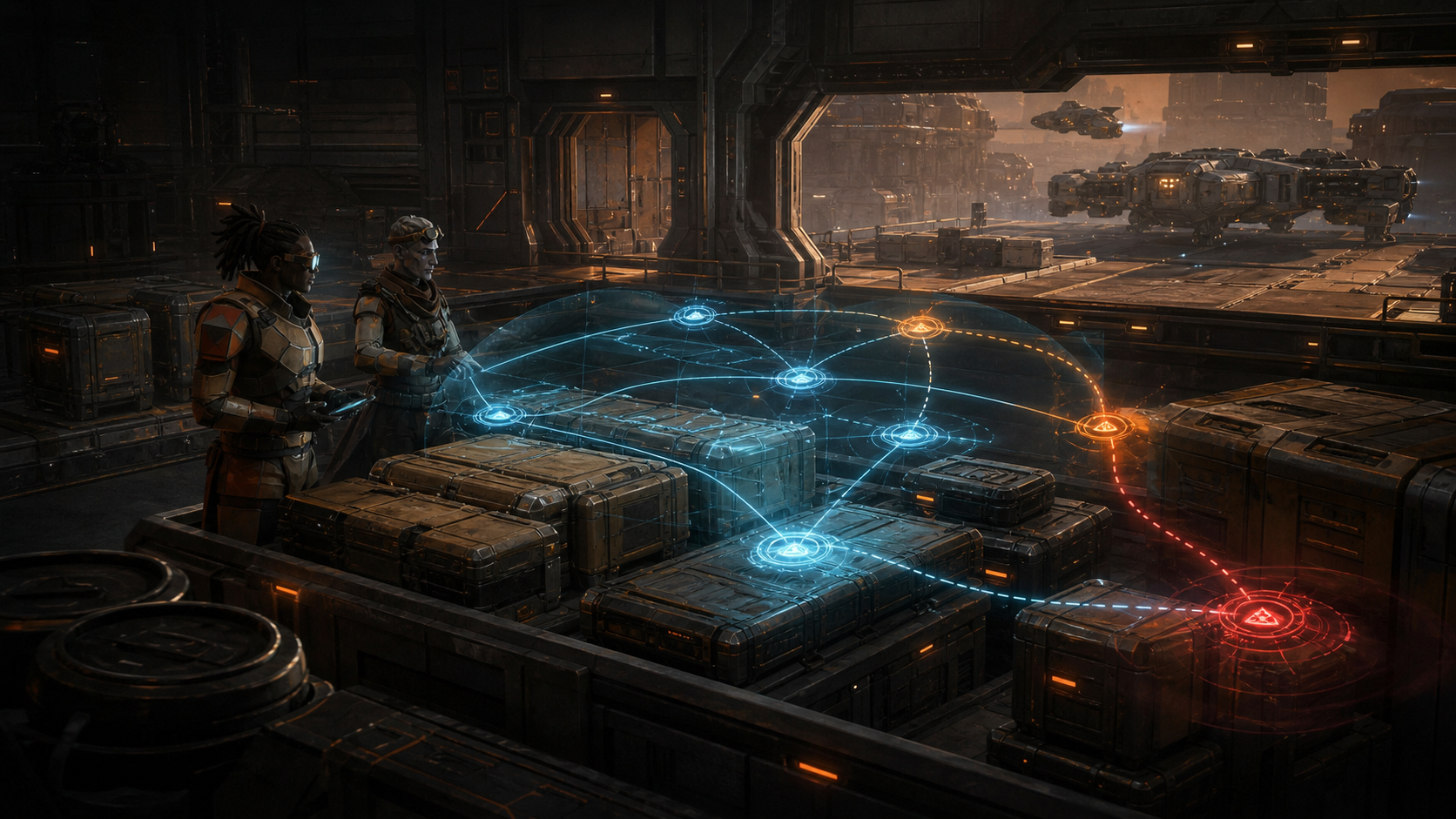
The Port Authority system lets players accept NPC-generated trade contracts, load cargo to a specific ship instance, move it between stations, and complete the contract for in-game CROWN-denominated profit. Cargo is bound to the exact ship instance that loaded it, making logistics and ship choice part of the gameplay loop.
The system supports one active contract at a time, 24-hour contract duration, station validation, cargo status, route display names, and fee distribution. Product docs describe safe routes and dangerous gateway routes so risk can be exposed to players before they commit cargo.
Contract State
Available, active, cargo, completed
Cargo Binding
Specific ship instance
Fee Stream
Planet Warden distribution
Player Skill
Route, timing, and ship selection
07 / Ownership Tokens
Fee Participation Tied To Product Systems
Misfit Galaxy separates ownership-token utility by source. Station Overseer holders receive 5% participation in clone augmenting in-game CROWN fees, in-game CROWN marketplace fees, and CROWN/BITS exchange fees. Planet Warden holders receive Port Authority fee distributions. Eligibility checks include both linked Enjin wallet holdings and managed-wallet cached inventory holdings.
Fee participation is a revenue-funded distribution. It does not require minting new $MISFIT or returning burned tokens to circulation. Revenue allocations and token burns are separate records, so the same tokens are not counted as both burned and distributed.
These mechanics are implemented as product-specific distribution flows, not guaranteed investment returns. Fee activity depends on player usage, balance changes, indexing state, managed-wallet syncs, operational uptime, and future product decisions.
Station Overseer
Participation source: augmentation, in-game CROWN marketplace, and exchange fees.
Planet Warden
Participation source: Port Authority fee distributions.
Wallet Coverage
Both self-custody Enjin wallets and managed-wallet caches are considered for holder eligibility.
Controls
Distribution code includes holder-level idempotency and backfill tooling for operational repair.
08 / Hallow Port Shipworks
Shipworks Shares, Cache Access, And Blueprint Utility
Hallow Port Shipworks is a shareholder-style game system built around a configured share token, weekly cache windows, rank thresholds, marketplace stake balance checks, and rewards that can include components, capsules, and blueprint-oriented assets.
The current configuration includes a Hallow Port share token, a supply cap, a weekly cache credit model, a 48-hour activation window, and a 50% fee-share rate for module-crafting in-game CROWN fees into the Hallow Port pool. The system is tuned as an in-game access and participation layer rather than a promise of fixed payouts.
Ranks
Ranks start at Shareholder and scale through Majority Director based on share counts.
Cache Credits
Qualified holders receive cache access according to configured weekly rules and activity budgets.
Blueprint Buckets
Reward tables include weapon, module, fighter, mining, logistics, cruiser, and carrier blueprint categories.
Activation
Weekly claim windows and final-claim timing control when cache participation opens.
09 / Ships And Modules
Modular Ships And Upgradeable Fleet Roles
Ship progression is designed as a fleet-wide upgrade layer, not a single-ship feature. Pilots unlock ships across role classes such as Interceptor, Fighter, Mining, and Hauler, then shape each hull through crafted modules, installed hardpoints, and ship-system upgrades that determine how the ship performs in combat, extraction, hauling, and dangerous-route logistics.
The module path lets players collect components, craft category-specific modules, roll a bonus value, finalize the module into inventory, and install or uninstall it into ship slots. Module categories include Turret, Missile, Tank, Rift, and Pirate, with backend-served stat keys and bonus ranges so Unity can apply the current build from PlayFab ReadOnlyData.
Beyond installed modules, ship upgrades cover core systems such as Shield, Armor, Energy Capacitor, Evasive Maneuvers, Hull, and Engine through a shared point budget. Primary Weapon and Laser upgrades operate as separate weapon tracks. Together, these systems let the same economy support fast interceptors, heavy fighters, miners, haulers, and future specialized hulls without forcing every pilot into one optimal build.
Crafting Drives Repeat Game Activity
Crafting uses components, BITS, and other materials to turn game activity into fleet progression. When players deposit funds by credit card or stablecoin for premium content, the planned 2% deposit fee goes entirely toward $MISFIT buybacks and burns. Consuming crafting materials or existing premium balances is not itself a burn of $MISFIT.
Hull RoleInterceptor, fighter, miner, hauler
CraftComponent-driven modules
UpgradeShip systems and weapons
SyncPlayFab-backed live build
10 / Treasury And Wallets
Track Fees, Burns, And Rewards Separately
The treasury will account for card and stablecoin deposit fees, $MISFIT buyback budgets, completed burns, company revenue, liquidity allocations, and stablecoin player rewards as separate flows. Money allocated for a buyback is only reported as a token burn after tokens have actually been destroyed on-chain.
Reporting should show deposit and swap volumes, fees collected, the amount allocated to each destination, actual $MISFIT burned with supporting transactions, and stablecoins paid to players. The same fee revenue cannot be counted as both a burn budget and a rewards payment.
The Uniswap v4 token network and pool deployment remain to be confirmed. Existing Solana USDC settlement paths and Enjin asset services are separate from the planned hook-based trading system; they do not establish a Uniswap v4 deployment on Solana.
Deposit Fees
2% of credit card and stablecoin deposit value, allocated entirely to $MISFIT buybacks and burns.
Trading Fees
Planned 1.25% pool swap fee: 0.25% liquidity, 0.5% buybacks and burns, 0.5% stablecoin rewards.
Player Rewards
Funded by collected swap fees, with in-game transaction volume and playing time determining participation under the launch rules.
Owned Assets And Settlement
Enjin remains the asset layer for selected NFTs and managed inventory. Existing eligible USDC withdrawals remain subject to reserve coverage, limits, and review.
11 / Roadmap
Alpha Traction To Full Beta
Misfit Galaxy is currently in alpha playtesting with approximately 100 daily active users and D7 retention at 23%. The current goal is to continue proving the MMO loop in live conditions while expanding the amount of playable space, station variety, ship choice, and Rift content ahead of full beta.
Current Stage
Alpha playtesting
DAU
100
D7 Retention
23%
Servers
MMO live and stable
Now / Alpha Online
All Current Core Systems Live
The current alpha includes stable MMO servers, Epic Games Store release/distribution, account and player portal, PlayFab-backed player data, live combat, mining, hauling, trading, station resources, outpost supply, Port Authority cargo contracts, procedural Rift systems, marketplace trading, guilds, leaderboards, Most Wanted and bounty systems, NPC kill tracking, daily missions, Multiverse quests, Twitch-linked rewards, help-agent support, and admin operations.
Now / Economy Online
GameFi And Ownership Systems Live
Active economy systems include in-game CROWN, BITS, Crelyte, Telemetry, Obscurian, clone ownership, clone factory, clone augmentation, stat capsules, Stat Essence, capsule upgrading, custom clone delivery, managed wallets, Enjin asset integration, digital token pages, NFT migration, ownership-token earnings, Station Overseer and Planet Warden fee participation, Hallow Port Shipworks, shareholder caches, marketplace asset listings, ship module crafting, ship upgrades, and withdraw-pool accounting.
Q4 2026
Full Beta Expansion Target
By Q4 2026, the roadmap targets expansion to 20 new systems, 6 station biomes, a broader ship offering, expanded procedural Rift content, continued MMO server stability, and a full beta release. This phase is designed to move the alpha economy from proven systems into a larger galaxy with more route density, biome identity, ship specialization, and repeatable endgame activity.
Full Release
TBD
Full release timing remains TBD. The release date should be set only after beta data supports server stability, retention, economy balance, content depth, payment, $MISFIT pool, buyback, reward, and USDC settlement readiness, and the ability to operate live events and player markets at larger scale.
12 / Risks And Disclosures
Material Risks
Misfit Galaxy is a live game and software platform. Investors, founders, players, and partners should understand that product mechanics can change and digital assets carry operational, market, regulatory, and technical risks.
Gameplay Risk
Rewards, fees, asset utility, drop rates, routes, and balance can be changed for health of the game.
Chain Risk
The selected token network, Uniswap v4 hook execution, stablecoin liquidity, existing Solana settlement services, Enjin indexing, and transaction costs can affect user experience and reward availability.
Custody Risk
Managed wallets reduce onboarding friction but require secure backend operations, daemon controls, and withdrawal policy enforcement.
Regulatory Risk
Laws and platform rules around digital assets may change. This whitepaper is informational and should not be treated as legal, tax, or financial advice.
No guaranteed return: fee participation, marketplace activity, in-game CROWN eligibility, cache access, and USDC withdrawal availability depend on actual product usage, operational settings, reserve coverage, and future policy.